
The Library Did Not Burn

The Library of Alexandria is popularly supposed to have burned. The supposition persists, in part, because a fire supplies the catastrophe with a date and a culprit, and implies that knowledge perishes only when somebody destroys it.
The scholarship unfortunately points to a duller conclusion.
Papyrus decays in the Mediterranean climate unless scribes continually recopy it; recopying requires money and trained labor; and over several centuries the administrators who controlled both found, year after year, that the work could be deferred. Mice and humidity destroyed whatever the copyists neglected, until the collection that had drawn Eratosthenes and Euclid to Egypt ceased to exist as anything more than furniture.
The common claim that the destruction of the library brought on a dark age is thus false; its abandonment is better read as evidence that the dark age had already come, since a civilisation that still valued what the scrolls contained would have paid to keep them readable.
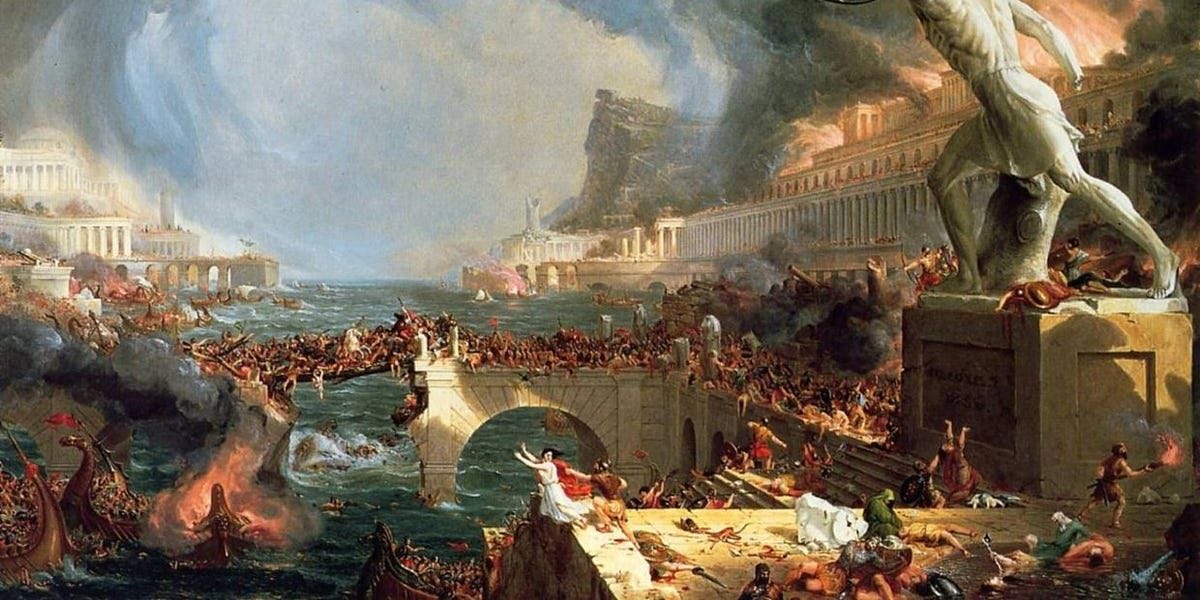
I begin with Alexandria because the popular version of its story governs how we imagine our own situation. We assume that if comprehension were ever taken from us it would be taken violently, by censors or vandals.
The actual condition of the present involves no destroyer at all: we have never been surrounded by so many words and yet so unable to comprehend them.
The quantity of text now in circulation exceeds anything in history, and the quantity tells us nothing, because comprehension is an activity that occurs in a reader or does not occur at all, and the activity is measurably declining while the text accumulates.
Fewer than half of American adults opened a book of any kind in 2022, the proportion who read for pleasure on a given day has nearly halved in twenty years, and placing a bet has become a more common pastime than finishing a book of any description.
To see why the abundance is compatible with the decline, consider what a piece of text actually is. A book does not contain meaning in the way a jar contains oil, with the contents sitting inside the object waiting to be poured out. The marks on the page are inert, and they become thought only when a reader performs the act of thinking. Where this performance is absent, the book is little more than decorated paper.
It follows, therefore, that the true library of a civilization consists of its readers rather than its books, and that counting volumes of words measures nothing of consequence. Our moment tests this conclusion severely, since digital storage has made every text ever scanned available to anyone within seconds, so that by the jar theory of meaning we inhabit the greatest library in history, while by the performance theory we are standing in a concert hall stacked to the ceiling with scores, watching the orchestra leave.
Interestingly, no region of the brain evolved to be optimised for reading; every literate person has repurposed neural circuitry originally meant for speech and for the recognition of objects, through years of deliberate practice, and retains the capacity only so long as the practice continues.
In this respect, reading much more closely resembles a characteristic like strength rather than one like sight, for sight maintains itself without attention, while strength answers to use and to disuse with equal indifference.
Researchers in Kansas recently asked English majors, with the entire internet at their disposal, to read the opening paragraphs of Bleak House:
London. Michaelmas term lately over, and the Lord Chancellor sitting in Lincoln’s Inn Hall. Implacable November weather. As much mud in the streets as if the waters had but newly retired from the face of the earth, and it would not be wonderful to meet a Megalosaurus, forty feet long or so, waddling like an elephantine lizard up Holborn Hill.
A quarter of them concluded from the figures of speech that dinosaurs walked the streets of nineteenth-century London, and only five percent arrived at an accurate understanding of the passage, which is to say that the rest moved their eyes along the lines while the act the lines were written for never took place.
Writing holds language still, and language held still becomes an object that can be examined and doubted, reread against itself, convicted of contradiction by a single reader working alone, so that the critical tradition in its entirety descends from the arrangement of one mind kept in the company of one fixed text.
Something more intimate descends from the same arrangement. Augustine records his astonishment at seeing Ambrose read without moving his lips, the sense passing silently inward, and the astonishment shows that private reading was once a remarkable practice; the interior chamber in which a person deliberates alone and at length was constructed by that discipline and has been maintained by it ever since, so that a general failure of sustained reading threatens both.
Socrates would have recognised our alarm, and his case is very interesting to the present moment. In the Phaedrus he argued that writing should be avoided for that it will create forgetfulness, since learners will trust the external marks and cease to remember from within. In some ways this indictment proved accurate, for literate people have never been able to remember in the same manner and extent as the trained bards of the oral world remembered.
Every medium is a prosthesis, and a prosthesis wastes the limb it replaces. Writing wasted the bard’s memory and built the fixed text and the accumulating record that allowed each generation to begin where the last had stopped.
Now the medium is the feed. The feed consumes attention and it builds nothing that requires the faculty it consumes; video presses more information on the viewer per second than any page of a book while producing less thought.
Ong called the destination secondary orality, meaning the reversion of a lettered culture to the habits of speech, in which the epithet does the work of the argument and a speaker contradicts himself freely, his words leaving no record against which he can be caught, and meaning attaching to the speaker rather than to anything the speaker has said.
The consequences reach the constitutional order, for the American founding was drafted on paper by men who assumed a reading public, Franklin boasting that the lending libraries had made tradesmen as intelligent as gentlemen, and the consent of the governed presupposes comprehension in the governed; a politics conducted in writing must at least survive rereading, while a politics conducted in the feed need only survive the interval before the thumb moves on.
AI arrives into this situation as an event of a different order, because every previous technology of language automated the carrying of thought from one mind to another, while this one automates the forming of thought itself.
Whether such an automation costs anything depends on where the value of the automated act resided. The calculator performs computation on our behalf and little was lost, since the value of computation lay in its result, and nobody’s inner life was built by long division.
The value of writing lies elsewhere, for the sentence will not form until the thought has formed, so that the labor of composition is the labor of discovering what one actually thinks, and the finished text stands to that discovery roughly as a receipt stands to a purchase. A machine that writes on a person’s behalf accordingly hands over receipts for purchases never made and conclusions of deliberations that did not occur. The early evidence behaves as this account predicts, for students who delegate their writing to the machine afterward test worse even on questions that demand no knowledge, only reflection, as reflection is the very operation they contracted out.
You have read some twelve hundred words of continuous prose to arrive at this sentence, and the effort it has cost you is the exact act this essay has been describing, caught in the moment of its occurrence.
That act was always paid for reader by reader, in the same way the Library of Alexandria was paid for scroll by recopied scroll, by people who decided daily that the maintenance was worth the expense, and there exists no institutional substitute for their decision, since a ministry cannot make it, a curriculum cannot compel it, and the texts themselves are indifferent, having survived in perfect condition into an age that finds them too expensive to perform.
The last scribes of Alexandria did not decide to end anything. Each generation copied somewhat less than the generation before it and found the shortfall reasonable, and the scrolls, which were still perfectly legible when the copying stopped, sat in their racks available to anyone while the humidity worked on them.
The mice did the rest of the destruction.
This essay was inspired by https://www.theatlantic.com/magazine/2026/08/reading-crisis-postliterate-age/687618/ - an essay I was kindly gifted to read by The Atlantic
I think the main point about the value of *critical* reading stands, but I'm not sure that there is a major decline in reading comprehension.
However, I'm not sure that the evidence actually points to major declines in critical reading ability. The one piece of evidence you give is the one passage of Bleak House. I personally did catch the fact that the passage didn't say that there literal were dinosaurs walking around London, but also I was very confused about what this metaphor is trying to achieve. I can't think how the sight of mud in the street could make you think of dinosaurs. So I honestly wouldn't blame anybody by being confused by this weird metaphor. In fact, you could say that people are using their critical thinking capacity, when they are confused by this bad metaphor; and maybe one conclusion you could draw that it may not be a metaphor at all.
Wow, this really inspired me to read more. A great business idea is to sell a book after all this 😂. Thank you for informing us!